
I’d stacked all the tables and chairs, loaded the car with my art stuff, driven…
Patience

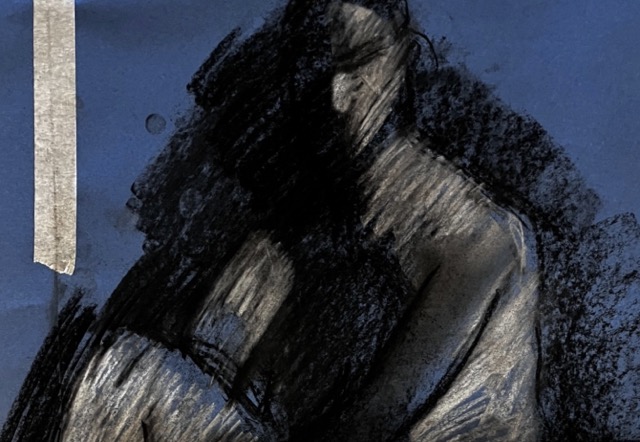
Rather than lie still or recline, as models often do at traditional, art school ateliers, the life model walked slowly around the room, pausing only to hold a pose for one or two seconds before moving on. As she moved, the students stared fixedly at her, resisting the urge to glance at their paper for even a second. To do so, would be to miss what was happening in front of them. And what was happening in front of them and between them and the model was far more important than anything that was happening on their piece of paper
The concentration was intense. There were sixteen people in the room as the model worked carefully around the space, but all I could hear was the soughing of charcoal on paper, like a breeze stirring dry leaves. After ten minutes, I called a halt and an involuntary sigh issued from just about every artist in the room. The model, too, was pretty glad that the exercise was over. When I asked the class for feedback, somone said, “I feel like I’ve just lost ten minutes of my life that I’ll never get back.”

The memory of this session popped into my head the other day, after an effortful two hours with one of my watercolour groups. The exercise we’d worked on all morning had required a great deal of concentration, a lot of careful painting and a fair bit of literally watching paint dry. At going-home time, a student said, “I understood the point of it, but I just don’t have the patience.”
Yes. Every now and then, I dream up an exercise that would try the patience of a saint.
My interest in patience began many years ago, when I was holding down a night-driving job for the emergency doctors’ service in Bath. We had thousands of patients on our database and every night, there was a good chance that a least a dozen of them would keep us busy from 11pm until 8am the next morning. But what exactly was a patient, I wondered?
Sometimes, I was in the car all night, which required a fair degree patience on my part, I suppose. But what did it mean when the most patient patients were often the most seriously ill, while the ones with earache or a hangover sometimes had no patience whatsoever? What was I missing? Well, ‘patient’ and ‘patience’ can both be nouns, of course and derive from the Latin verb, ‘patiens’ meaning ‘to suffer.’

From the moment I learned this, vast swathes of my childhood became clear to me. When my mum and I were visiting my nan, for example and Nan was going on and on about her neck and her legs and everything in between, while all I wanted was to go home and play with my Dinky Toys, Mum would say, “Be patient.”
In other words, ‘suffer.’
I was expected to sit it out until whatever ‘it’ was was all over. Suffer, David – and in silence, preferably. In this way, seemingly precious moments trickled through my fingers on an almost daily basis.


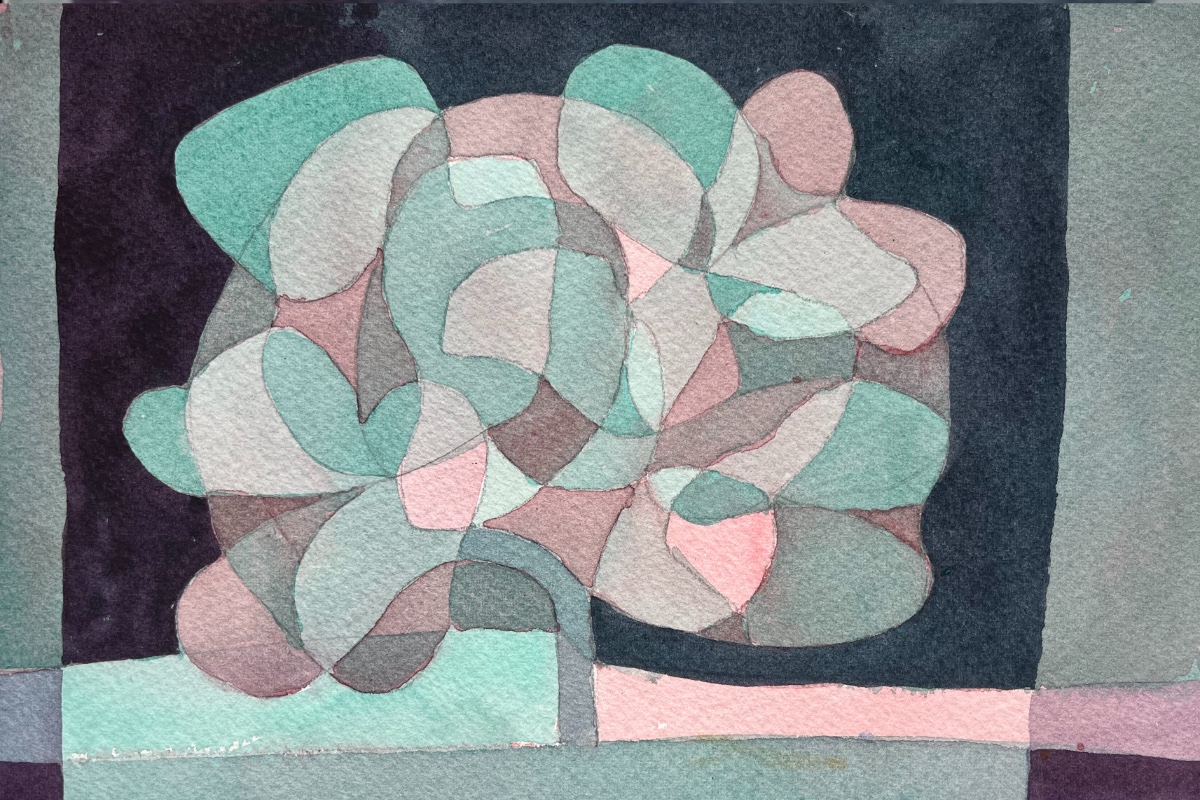
Take the Paul Klee exercise that sparked off this entire ‘patience’ thing, for example. The object of the exercise was to carefully glaze one dilute colour over another to obtain a grey. So, you start with a lovely, rich green and you water it down until looks like you’ve been blanching broccoli with it. Then you dip your brush in it, apply it to your paper and let it dry. Once dry, you place a red over it that’s so thin, it’s barely even a blush. The two colours, if we can call them that, cancel one another out and the result is a grey. You then repeat the process and when you do, the green makes the grey look faintly cold and the red warms it up a bit. And you go on in this way for some time with cool grey over warm grey, over cool over warm etc., etc.
After the kind of winter we’ve had, it’s almost too much to bear, I suppose. But here’s the thing, after all that grey and what seems like an eternity, the green and the red begin to appear again. All those tiny molecules of green and red pigment modulate the light that is reflected by the white of the paper, which strikes the retina with luminous colours of subtly shifting shades.
 Those beautiful colours could never materialise if you didn’t first suffer ‘all that grey.’
I think it would benefit most of us artists if we behaved more like scientists and treated everything we do as an experiment. Scientists don’t castigate themselves and chuck it all in the bin when they’re not getting the results they want. They suffer their results. They learn from them. They’re patient with them and with themselves, too. If we can do that, then nothing we do can ever be a waste of our valuable time again.

Related Posts


Comments (0)